 English

Views: 0 Author: Site Editor Publish Time: 2026-06-10 Origin: Site


The debate around minimalist footwear remains intensely polarized today. Die-hard advocates often claim barefoot shoes cure all joint pain and revolutionize movement. Conversely, traditional podiatrists warn of stress fractures and severe Achilles injuries. Assuming "natural" automatically means "safe" ignores the harsh realities of our modern environments. You cannot treat minimalist footwear as a universal magic bullet. Instead, you must approach it as a specialized tool requiring careful mechanical adaptation. We will explore how barefoot health relies entirely on biomechanical changes and your walking surfaces. You will learn to navigate the pathological matrix to determine your exact risk profile. We will also reveal how using Barefoot Water Shoes on natural terrain provides the safest entry point before hitting concrete.
Barefoot shoes shift impact forces: they reduce knee strain but transfer the load to the Achilles tendon and calves (the "Risk Transfer Model").
Transitioning too fast on hard, modern surfaces (concrete) drastically increases the risk of bone marrow edema and plantar fasciitis.
A wide toe box is not the same as a "wide shoe"; toe splay is critical for natural stability.
The safest way to test minimalist footwear is through cross-training in natural, forgiving environments using barefoot water shoes.
Gradual exposure (starting with 20-30 minutes a day) is a non-negotiable requirement for a safe transition.
Minimalist footwear fundamentally changes how your body interacts against the ground. To understand this shift, we must define the core anatomy distinguishing barefoot designs from traditional athletic wear. Barefoot footwear relies on four distinct structural pillars.
Shoe Feature | Traditional Footwear | Barefoot Footwear |
|---|---|---|
Heel Drop | 10-15mm elevation | Zero-drop (completely flat) |
Sole Thickness | 20-30mm thick cushion | 3-10mm thin flexible sole |
Toe Box | Tapered, constricting toes | Wide, allowing natural splay |
Arch Support | Rigid, artificial lift | Zero artificial support |
These four structural pillars dictate your kinetic response. Traditional shoes typically feature a 15mm heel drop. This elevation acts similar to a medical cast. It forces a Rearfoot Strike (RFS), meaning your heel absorbs the initial ground contact. Thick cushioning also dulls your sensory perception of horizontal braking forces. We call this horizontal shear. When you lose feeling in your feet, your body naturally over-extends, increasing strain.
Switching to zero-drop designs encourages a natural Forefoot or Midfoot Strike (FFS/MFS). Academic consensus confirms this shift reduces the maximum Vertical Ground Reaction Force (GRF). It significantly lowers patellofemoral pressure, sparing your knees. However, we must recognize the "Risk Transfer" reality. The mechanical load does not simply disappear. It transfers downward into the ankle and the Achilles tendon.
Think of your foot as a car suspension system. Your bones, tendons, and intrinsic muscles act as natural shock absorbers. When you walk barefoot, this suspension system engages fully. The Achilles stretches and recoils, storing and releasing elastic energy. But this highly efficient natural shock absorber only works well if the muscles are conditioned to handle the load.
Best Practice: Always evaluate your ankle mobility before attempting a zero-drop shoe. Tight calves will bear the brunt of the transferred load, risking severe Achilles strain.
Brands heavily market the evolutionary argument. They correctly state human feet evolved for millions of years functioning entirely barefoot. However, this marketing often relies on the "natural" fallacy. Yes, human feet evolved for barefoot movement. But they evolved to navigate soft, uneven, forgiving natural terrains like dirt, grass, and mud.
Our ancestors did not walk on unyielding modern concrete or asphalt. A critical surface mismatch occurs when you take a minimalist shoe onto a city sidewalk. Walking barefoot on a completely flat, artificially hard surface removes the continuous micro-adjustments your foot relies upon. In nature, every step lands slightly differently, distributing physical stress across different ligaments and muscle fibers. On flat pavement, your foot hits the exact same angle repeatedly, drastically increasing repetitive mechanical stress.
Common Mistake: Many beginners assume they can wear zero-drop shoes for an eight-hour shift on hard warehouse floors. This surface mismatch is the leading cause of early transition injuries.
Because of these modern environmental challenges, we must distinguish between extreme separated-toe designs and sensible minimalism. A decade ago, separated-toe shoes dominated the market. They generated widespread legal controversies over exaggerated health claims. The U.S. Army even banned soldiers from wearing separated-toe shoes during training, citing safety and uniform standards. Today, unified wide-toe-box designs provide a safer, compliant alternative. They offer the necessary toe splay room while maintaining structural integrity for modern environments.
We must evaluate minimalist footwear through a strict medical lens. Barefoot shoes serve as an exceptional training tool for specific populations. Conversely, they present serious medical risks for others. Review the evaluation criteria below to determine your candidacy.
Weightlifters: Athletes performing squats and deadlifts require a stable, grounded base. Zero-drop soles prevent forward pitching and improve overall posterior chain alignment.
Individuals experiencing mild bunions or hammer toes: A wide toe box relieves lateral pressure on the metatarsals. This space allows compressed toes to finally relax and splay naturally.
Experienced athletes: Runners using minimalist designs as a dedicated cross-training tool can significantly strengthen intrinsic foot muscles and improve overall running economy.
Individuals exhibiting severe overpronation: Without structured support, severe overpronators risk internal rotation of the knee and hip.
People nursing existing Achilles tendinopathy: Because zero-drop designs transfer mechanical load directly to the calf, existing tendon injuries will rapidly deteriorate.
Patients possessing a history of metatarsal stress fractures: Thin soles offer no protection against vertical impact. They lack the necessary dispersion capabilities for weakened bones.
The elderly or individuals diagnosed with peripheral neuropathy: These demographics require maximum stability and a larger surface contact area to prevent falls. They often lack the proprioception needed for ultra-thin soles.
Narrow-footed individuals: People possessing very narrow feet might experience internal sliding. You must check specific brand volume carefully, as excess lateral space causes blisters and instability.
Since modern concrete creates the primary injury risk during your transition phase, you must find safer environments. The absolute safest place to build intrinsic foot strength is on natural surfaces. Beaches, riverbeds, and soft woodland trails provide the yielding, variable terrain your feet crave.
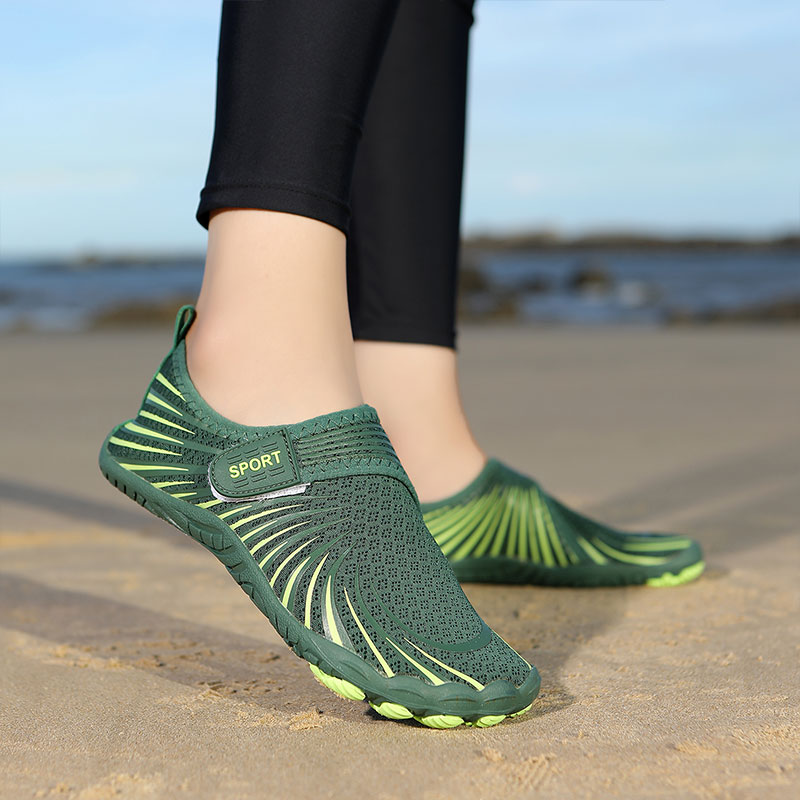
Instead of purchasing expensive minimalist running shoes for daily pavement use, you should bridge the gap first. We recommend utilizing Barefoot Water Shoes as your ideal entry-level investment. They smoothly solve the surface mismatch problem.
These shoes provide the exact zero-drop and wide-toe-box biomechanics required to rebuild foot strength. More importantly, they protect your soles against environmental hazards like hidden glass, sharp river rocks, and scorching hot beach sand. You get the biomechanical advantages of barefoot movement without the environmental risks.
You can easily integrate this tool into your routine through weekend cross-training. Wear them during specific outdoor activities. Kayaking, casual beach walking, or light trail wading represent perfect low-risk cross-training methods. Spending a few hours on soft sand forces your toes to splay and grip naturally. It gently wakes up dormant arch muscles. By starting your journey in forgiving environments, you condition your biological suspension system safely before ever attempting to tackle city sidewalks.
Patience remains the most critical factor in avoiding bone marrow edema. Transitioning requires strict discipline and a structured schedule. Follow this three-step protocol to safely acclimate your anatomy to zero-drop footwear.
You must dictate a strict exposure schedule. Start by wearing your minimalist shoes for only 20 to 30 minutes a day. Do not run in them immediately. Use them for casual walks around the house or the yard. Increase your weekly duration by no more than 10%. Your muscles might adapt quickly, but your bones and tendons require months to remodel.
Timeline | Activity Type | Maximum Duration |
|---|---|---|
Week 1 | Indoor walking, light yard work | 20-30 mins / day |
Week 2 | Soft surface walking (grass/sand) | 30-35 mins / day |
Week 3 | Errands on mixed surfaces | 40-45 mins / day |
Week 4 | Extended natural trail walking | 50-60 mins / day |
You must learn to distinguish between healthy muscle soreness and dangerous tissue damage. Dull, achy fatigue in your arches or calves indicates your intrinsic muscles are working harder. This is a positive sign of strengthening. Conversely, sharp pain in your heel, localized throbbing in your bones, or intense burning in your Achilles tendon means you must stop immediately. Bone and tendon pain signals impending injury.
Actionable routines prepare the foot for new mechanical loads. Implement these three daily exercises:
Short Foot Exercises: Stand barefoot. Without curling your toes, attempt to pull the ball of your foot toward your heel. This action contracts and lifts the arch, strengthening the plantar intrinsic muscles.
Toe Splaying: Sit comfortably. Actively spread your toes as far apart as possible. Hold for five seconds. This restores motor control to the digits.
Daily Calf Raises: Stand on a stair edge. Slowly lower your heels, then press up onto your toes. This routine fortifies the Achilles tendon, preparing it to handle the newly transferred load generated by zero-drop footwear.
Barefoot shoes are not inherently good or bad. They operate as a highly effective strengthening tool requiring respect, discipline, and the right environment. We have seen how zero-drop anatomy shifts the kinetic load away from the knees and onto the calves. We also recognize the stark mismatch between ancient evolutionary feet and modern concrete cityscapes. By respecting the pathological matrix, you can accurately determine if your body is ready for this change.
Start your minimalist journey far away from unyielding pavement. Begin by rebuilding your foot strength on yielding, natural surfaces like sand and dirt. We highly encourage you to explore high-quality Barefoot Water Shoes for your next outdoor or aquatic adventure. They represent a safe, practical, and highly effective first step into the world of minimalist footwear.
A: They can help strengthen the intrinsic muscles that support the arch over time, but those with severe, rigid flat feet should consult a podiatrist first.
A: A wide shoe is wide throughout the midfoot and heel, which can cause heel slippage. A wide toe box specifically allows toes to splay naturally while keeping the heel and midfoot secure.
A: Not initially. Without proper transition, prolonged use on unyielding surfaces drastically increases the risk of bone marrow edema and plantar fasciitis.


