 English

Views: 0 Author: Site Editor Publish Time: 2026-06-17 Origin: Site


The footwear industry throws around the term "all-terrain" casually. Buyers often get burned relying on these marketing claims when stepping into hybrid environments. Transitioning from rocky shores to wet boardwalks quickly exposes a shoe's true capabilities.
Standard water shoes lack the structural support necessary for sustained walking. Meanwhile, traditional hiking boots become unbearably heavy and uncomfortable once they get wet. You end up compromising on either safety or comfort.
We need to define what genuinely makes a shoe capable of handling every surface. This guide provides a rigorous, evidence-based framework for evaluating these designs. You will learn how to shortlist All-Terrain Beach Footwear capable of performing across wet, dry, and unpredictable coastal landscapes.
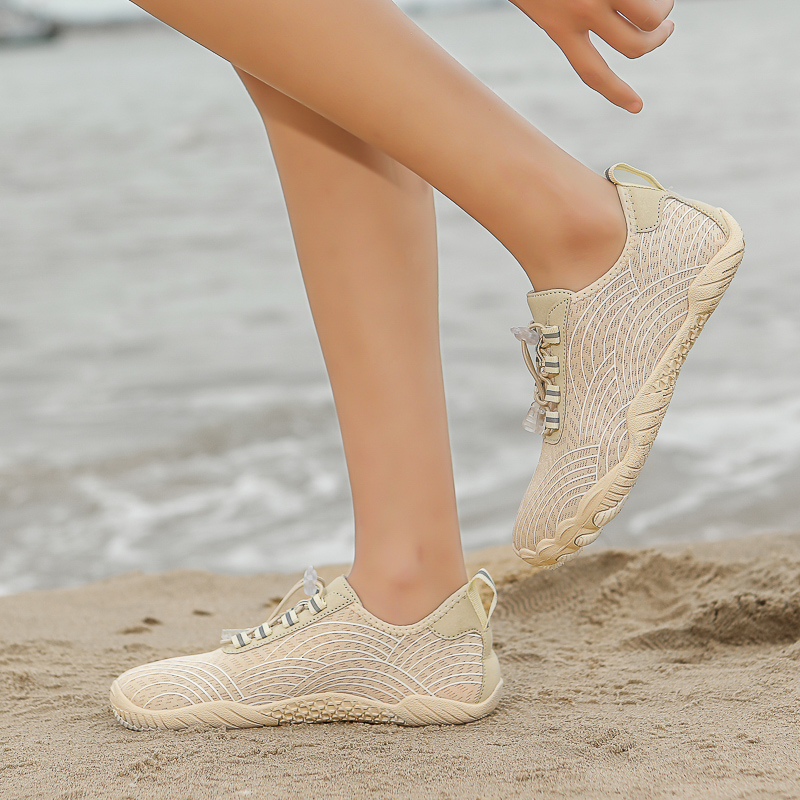
"All-terrain" implies a specific synergy between high-traction outsoles, rapid fluid drainage, and structural foot support, not just a rugged appearance.
Authentic All-Terrain Beach Footwear must solve the "wet-to-dry transition" problem without causing friction blisters or retaining abrasive sand.
Evaluating these shoes requires looking past aesthetics to verify outsole lug geometry, upper material porosity, and midsole stability.
A verifiable all-purpose walking shoe for coastal environments must balance slip resistance on wet terrain with comfort on pavement.
A baseline definition separates legitimate gear from casual wear. All-terrain signifies consistent grip, foot protection, and climate adaptability. It performs reliably across sand, jagged rock, mud, and pavement. It must transition seamlessly between these zones. You should not feel a sudden drop in stability when stepping from a dry trail into a tidal pool. The outsole must respond predictably. The upper must handle rapid temperature changes. True versatility demands exceptional material engineering.
Many buyers rightly feel skeptical about outdoor gear claims. An aggressive-looking tread alone does not mean a shoe is ready for slippery environments. Some rubber compounds harden dramatically when submerged in cold water. They become slick and dangerous on wet stones. You must look for siping. These tiny water-channeling grooves push moisture away from the contact patch. Siping works exactly like treads on a rain tire. It maximizes surface area contact. We cannot trust a rugged appearance if the underlying chemistry fails.
Feature Category | Marketing Claim | Technical Reality |
|---|---|---|
Outsole Grip | "Deep, aggressive treads for any surface" | Lugs must feature siping and utilize soft, marine-grade rubber to grip wet surfaces. |
Water Resistance | "100% Waterproof construction" | Waterproof shoes trap water inside. Drainable, hydrophobic materials actually perform better. |
Foot Support | "Barefoot feel for natural walking" | Walking over jagged rocks requires a rigid shank or dense midsole to prevent stone bruising. |
Real-world usage drives this specific demand. People want one single pair for their entire day. You might start out wading through coastal waters. Later, you hike up a steep seaside trail. Finally, you walk into town for dinner. Nobody wants to switch footwear midway through the afternoon. Carrying multiple pairs of shoes adds unnecessary bulk to your pack. Legitimate All-Terrain Beach Footwear handles this entire spectrum gracefully. They provide the agility of a sneaker alongside the resilience of a wading boot.
Look closely at the feature-to-outcome ratio when evaluating outsoles. Proprietary slip-resistant rubber compounds matter heavily. Standard hiking rubber slips easily on wet organic matter. Marine-grade rubber maintains a softer durometer (hardness rating) to grip slick surfaces. Multi-directional lug patterns hold your foot steady regardless of your walking angle.
Criteria: Verify the presence of siped rubber and multi-directional lugs.
Outcome: You prevent catastrophic slips on algae-covered rocks. You stay upright on wet boat decks. You avoid dangerous falls during steep coastal descents.
Coastal environments demand rapid moisture evacuation. Hydrophobic upper materials form the first line of defense. Closed-cell meshes repel moisture rather than absorbing it. Traditional sponge-like foams hold water for days. Built-in midsole drainage ports push water out quickly as you step. Gravity and foot pressure work together to expel fluids.
Criteria: Check for non-absorbent upper fabrics and visible midsole drainage holes.
Outcome: This eliminates the dreaded "swamp foot" effect. The shoe sheds weight rapidly immediately after submersion. You reduce the risk of severe fungal infections.
Beaches present unique abrasive hazards. Fine sand particles destroy skin over long walks. You need gusseted tongues to seal the upper lace area. Tightly woven upper fabrics stop fine particles from intruding. Many water shoes utilize open netting. This netting invites sharp debris inside.
Criteria: Look for tightly knit meshes and fully integrated, debris-blocking tongues.
Outcome: This prevents sharp coral fragments and coarse sand from entering the footbed. Sand accumulation remains a critical failure point for most standard sandals. It causes agonizing friction blisters within minutes.
Best Practice: Always remove the insole when inspecting a new pair. Ensure the drainage holes penetrate completely through the sole. Fake drainage ports offer zero functional value.
This phase represents the primary lifestyle problem. A shoe must dry fast. Rapid drying prevents bacterial growth. It also stops friction injuries. Wet skin softens quickly. It becomes highly susceptible to blistering. Transitioning from ocean wading to walking down a dry street should feel comfortable. The materials must facilitate rapid evaporation through high airflow. If the shoe stays soggy, your hike will end early.
We must evaluate foam choices carefully. EVA (Ethylene-Vinyl Acetate) foam offers incredible lightness. Polyurethane delivers long-lasting density and durability. A true hybrid shoe requires a rigid shank or a highly dense midsole. You need protection against sharp impacts. Minimalist aquatic socks simply fail here. They lack the necessary underfoot armor. Walking two miles on a paved road wearing thin neoprene socks causes severe heel pain. You need legitimate shock absorption.
Material Type | Primary Advantage | Primary Drawback | Best Use Case |
|---|---|---|---|
Standard EVA Foam | Extremely lightweight and highly buoyant. | Compresses quickly over time. | Casual beach walking and light swimming. |
High-Density PU | Excellent long-term support and impact resistance. | Heavier and sinks faster in water. | Long coastal hikes carrying heavy backpacks. |
Dual-Density Hybrid | Balances shock absorption and lightweight agility. | Higher manufacturing cost. | True all-terrain hybrid transition zones. |
Style-conscious performance shows growing market demand. High-quality All-Terrain Beach Footwear blends seamlessly into casual settings. They should never look bizarre or overly technical on dry land. A neutral, modern design maximizes your return on investment. You can pack lighter for vacations. One well-designed pair transitions from morning kayaking to evening dining effortlessly. Bold neon colors often limit where you can appropriately wear them.
We must warn you about premature hardware failures. Eyelets, mesh panels, and glues face incredibly harsh conditions. They must be strictly marine-grade. Standard materials degrade quickly in salty environments. Salt crystals expand as they dry. This expansion tears weak fabrics apart. Your shoe will delaminate after just a few beach trips if the glue weakens. Always verify the manufacturer utilizes saltwater-resistant adhesives.
Your feet naturally swell during active coastal days. Heat and physical exertion expand tissue significantly. You need to know how different materials respond to this expansion. Neoprene stretches well to accommodate daytime swell. Engineered mesh holds its shape more rigidly. Plan your sizing strategy accordingly. Buying a perfectly snug shoe in an air-conditioned store often leads to afternoon agony on the beach.
Common Mistake: Sizing down for a "tighter grip" in the water. This restricts blood flow. Always leave a half-inch of space ahead of your longest toe to accommodate inevitable heat swell.
Manufacturers rarely discuss break-in periods for water shoes. We must remain transparent about expectations. Shoes featuring robust, trail-ready outsoles require a short break-in period. They do not bend instantly like flimsy beach slippers. The dense midsoles need time to conform to your unique foot arch. Wear them around your neighborhood first. Test them on short dry walks before embarking on a major coastal trip. Ignoring this step invites severe Achilles blistering.
Buyers should estimate their anticipated time split. Will you spend 70% of your time in sand and water? Or will you spend 30% on pavement and coastal trails? This ratio dictates how aggressive your outsole should be. Heavy trail use demands deeper lugs. Heavy water use demands maximum drainage above all else. Map out your typical vacation itinerary before shopping.
Eliminate poor designs early in your shopping process. Keep an eye out for these critical flaws:
Exposed, non-reinforced stitching: Threads placed in high-wear areas fray instantly when scraped against barnacles or rough rocks.
Open-toe designs: You expose your toes to sharp impacts. Navigating rocky tidal pools wearing open-toe sandals guarantees eventual injury.
Heavy leather or suede panels: These natural materials warp violently when exposed to seawater. They crack and shrink as they dry.
Lack of heel lock: Without a secure heel cup, the shoe will slip off entirely when submerged in deep mud or heavy surf.
We recommend comparing two or three shortlisted models side-by-side. Look closely at their specific outsole technology. Vibram® Megagrip and similar marine-grade rubbers perform best across varying moisture levels. Always verify the drainage features physically. Pour water through the shoe if possible. Ensure the water exits the sole immediately. Choose the model balancing structural rigidity and rapid fluid expulsion perfectly.
We must reiterate our core thesis clearly. "All-terrain" stands as a measurable technical standard. It is far more than a simple marketing tag used to sell basic sneakers. True capability requires specific engineering choices. You need specialized traction, rapid fluid evacuation, and robust foot support working together.
Investing in legitimate gear means prioritizing material science. Hydrophobic uppers and siped rubber always beat a famous brand name lacking these technical features. You cannot fake performance on wet, jagged rocks. The ocean environment punishes poor design relentlessly.
Take action before your next coastal adventure:
Check technical specifications for physical drainage ports.
Verify the presence of siped, marine-grade rubber outsoles.
Assess the midsole stiffness to guarantee proper arch support on hard pavement.
Ensure all materials utilize saltwater-resistant adhesives to prevent delamination.
A: Yes, provided the midsole offers adequate arch support and shock absorption. Purpose-built hybrid shoes are designed specifically for this crossover. They blend trail-ready stability with casual walking comfort seamlessly. You can easily transition from a wet beach to a paved city street without experiencing foot fatigue or pain.
A: You must perform a thorough freshwater rinse post-use. This preserves the adhesive integrity and removes microscopic salt crystals. Flushing the material also maintains the breathability of the mesh. Remove the insoles, rinse both components thoroughly, and let them air dry away from direct, baking sunlight.
A: No. There is a distinct difference between waterproof and water-friendly. Waterproof shoes keep water out completely, but they trap it entirely if water spills over the ankle collar. Water-friendly or drainable designs allow water to flow freely through the shoe. For beach environments, drainable is vastly superior.


