 English

Views: 0 Author: Site Editor Publish Time: 2026-08-04 Origin: Site


Navigating aquatic environments requires a precise balance between tactile ground feedback and underfoot protection—a balance often disrupted by traditional, elevated-heel water footwear. Consumers evaluating water shoes frequently face a dichotomy: heavily cushioned shoes that compromise proprioception and stability on slick surfaces, or hyper-minimalist options that fail to protect against sharp rocks, coral, or thermal variations. Selecting the correct zero drop water shoes requires a technical evaluation of the midsole structure. This guide breaks down how stack height, drainage architecture, and material density dictate performance, allowing buyers to match specific midsole constructions to their aquatic use cases while improving overall foot strength and posture.
Midsole Stack Height Dictates Application: Ultra-thin midsoles maximize proprioception for paddleboarding, while moderate-stack zero drop options are mandatory for river trekking and rocky shores.
Drainage Architecture is Non-Negotiable: Effective zero drop midsoles must utilize integrated drainage ports and hydrophobic materials to prevent waterlogging and maintain a lightweight build.
Flexibility vs. Protection Trade-off: True natural foot motion footwear requires high torsional flexibility, which must be carefully balanced against the need for puncture resistance in unpredictable aquatic environments.
Biomechanical Benefits & Transition Realities: A flat platform prevents forward lurching and reduces joint stress, but moving to zero drop aquatic footwear requires an adaptation period for the Achilles tendon and calf chain.
The primary function of a water shoe midsole is to provide a reliable protective barrier and structural support without altering the natural biomechanics of the foot. Traditional aquatic footwear often utilizes thick, rigid foam that elevates the heel above the forefoot. This design artificially alters the wearer's center of gravity. In dynamic aquatic environments, this artificial elevation creates severe instability. When you step onto a wet fiberglass deck or a mossy river rock, the midsole acts as your first line of defense and your primary sensory tool. The ideal midsole must protect the plantar surface from lacerations and blunt force impacts while allowing the foot to move, bend, and grip exactly as it would if bare.
Zero drop architecture refers to a geometric reality where the shoe features a 0mm heel-to-toe drop. The forefoot and the heel sit completely level on the same horizontal plane. Removing the elevated heel fundamentally changes how the body interacts with the ground. A completely flat platform encourages better posture and promotes a highly natural gait cycle. It eliminates the forward lurching and subsequent lower back slumping commonly caused by traditional footwear.
This level profile proves exceptionally critical in water sports. When balancing on dynamic, shifting surfaces like wet boat decks, floating docks, or paddleboards, a zero drop platform keeps the body's center of mass directly over the midfoot. This alignment significantly reduces structural stress on the knees and hips. The foot can rely on its intrinsic musculature to maintain equilibrium rather than fighting against an artificial incline.
Implementing a 0mm drop in aquatic environments yields several direct biomechanical advantages:
Center of Mass Alignment: Keeps the hips directly over the ankles, preventing the forward pitch that leads to slipping on wet inclines.
Achilles Tendon Engagement: Allows the tendon to operate at its natural length, acting as a biological shock absorber when jumping from a boat to a dock.
Forefoot Strike Promotion: Encourages a midfoot or forefoot strike during water crossings, which naturally dampens impact forces better than a heavy heel strike.
Tactile Ground Mapping: Levels the sensory receptors across the entire sole of the foot, allowing the brain to process terrain changes instantly.
Midsole engineering for aquatic environments diverges sharply from standard zero drop running shoe design. Running midsoles prioritize energy return, forward propulsion, and high-impact absorption on hard pavement. They utilize highly porous foams designed to compress and rebound rapidly. Water shoe midsoles must prioritize immediate water evacuation, rapid drying capabilities, and high tactile feedback. The materials used must withstand constant submersion without degrading or retaining excess weight.
Aquatic midsoles rely heavily on rot-resistant, non-absorbent foam compounds. Closed-cell ethylene-vinyl acetate (EVA) is the industry standard. Unlike traditional foams that act like sponges, closed-cell EVA prevents water from penetrating the core of the material. This ensures the shoe maintains a consistently lightweight build, even when fully submerged for hours. The density of this foam is carefully calibrated to offer enough compression to absorb the impact of jumping onto a wet dock, yet firm enough to prevent the foot from sinking deeply into the material and losing its proprioceptive connection to the ground.
The millimeter thickness of the midsole directly impacts user experience, safety, and long-term foot strength. Stack height dictates the distance between the bottom of the foot and the ground. Evaluating this dimension helps match the footwear to the specific hazards and requirements of the intended aquatic activity. A millimeter of difference in foam thickness completely changes how the foot reacts to a submerged obstacle.
Ultra-thin midsoles typically feature a total stack height ranging from 3mm to 5mm. These profiles define the core of minimalist aqua shoes. The primary outcome of this ultra-thin construction is maximum ground feel. Wearers experience the highest possible flexibility and a remarkably lightweight build that feels like a second skin. When you stand on a paddleboard, a 3mm midsole allows you to feel the exact texture of the grip pad, translating micro-shifts in weight directly to the board.
This minimal barrier actively engages the arch, ankle stabilizers, and the entire calf chain. Because the shoe provides almost no artificial support, the intrinsic muscles of the foot must work harder, gradually improving foot strength over time. Ultra-thin midsoles excel in environments where puncture risks remain minimal but sensory feedback is paramount. They are the optimal choice for sand walking, navigating pool decks, kayaking, and paddleboarding. In these scenarios, the ability to feel the board or the sand beneath the foot directly translates to better balance and control.
Moderate stack midsoles offer a profile ranging from 8mm to 14mm in total thickness while strictly maintaining the 0mm heel-to-toe drop. This increased thickness provides necessary shock absorption and vital protection against sharp objects. Users maintain a level, grounded stride without exposing the soles of their feet to severe bruising or lacerations. Carrying a heavy kayak across a gravel parking lot or portaging a canoe through a dense, root-filled forest requires this extra barrier.
These midsoles serve as an excellent bridge for users who want the biomechanical benefits of a flat platform but are not yet physically prepared for true barefoot minimalism. The extra foam dampens the harsh impacts of walking on jagged surfaces. Moderate stack designs are mandatory for aggressive river crossings, navigating rocky shorelines, canyoneering, and executing extended portages with heavy gear. The added thickness prevents sharp limestone or hidden submerged branches from causing debilitating foot injuries.
Selecting the right stack height requires navigating the trade-off between proprioception and protection. Buyers must weigh the critical need for sensory feedback against the environmental risk of stone bruises or coral cuts. High proprioception allows the foot to feel the exact angle and texture of a slippery river rock, enabling the toes to grip and the ankle to adjust instantly. However, too much ground feel on a jagged coral reef can result in immediate injury.
To resolve this trade-off, evaluate your primary aquatic environment using these criteria:
Substrate Evaluation: Identify the primary ground surface. Smooth sand and fiberglass decks favor 3-5mm stacks. Jagged limestone, oyster beds, and sharp gravel demand 8-14mm stacks.
Load Bearing Requirements: Consider the weight you carry. Moving only your bodyweight allows for thinner midsoles. Carrying a 40-pound pack or a heavy canoe drives the foot harder into the ground, requiring a thicker midsole to prevent bruising.
Duration of Exposure: Assess the time spent on your feet. A one-hour beach walk is manageable in ultra-thin shoes. A multi-day river trek requires the fatigue-mitigating properties of a moderate stack.
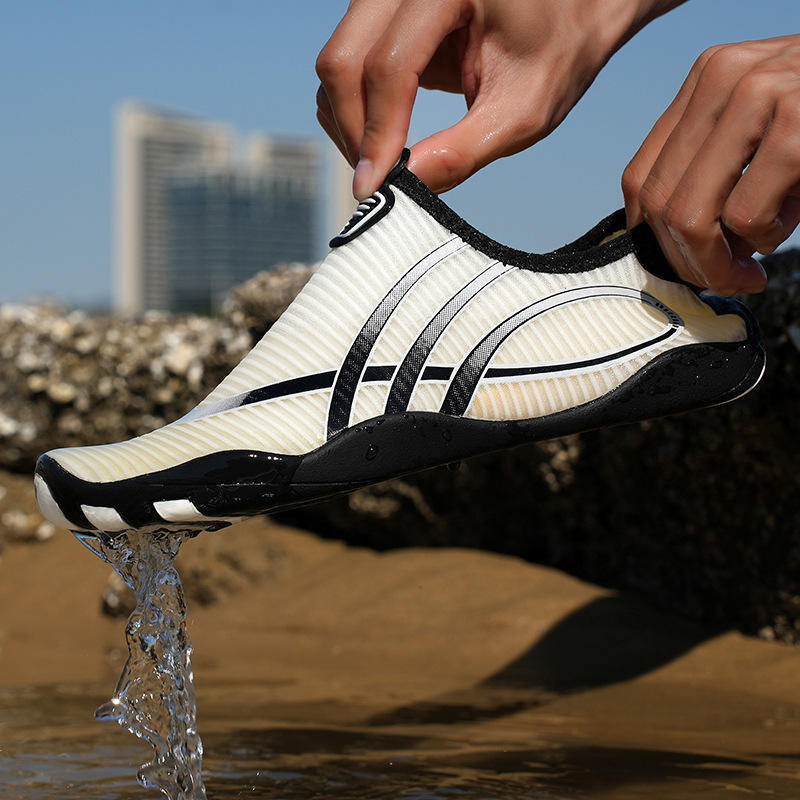
A water shoe is only effective if it can quickly shed the water it takes in. The midsole plays a central role in this process. Structural engineering used to evacuate water from the shoe prevents the footwear from becoming heavy, sloppy, and prone to causing severe friction blisters. When water remains trapped between the footbed and the sole of the foot, the skin softens rapidly, leading to maceration and skin tearing during high-movement activities.
Effective water management relies on integrated midsole drainage ports. These are engineered through-midsole channels that pass directly from the footbed, through the foam, and out the sides or bottom of the shoe. When the user steps down, the physical compression of the foot against the EVA foam acts like a mechanical pump, forcing water out through these channels instantly.
The placement of these ports requires careful evaluation based on the environment. Bottom-facing ports drain water exceptionally fast but carry a high risk of debris intake. Walking on fine sand or river silt can push abrasive particles up through the bottom ports and directly into the footbed. Side-facing ports mitigate this risk entirely. By routing the water horizontally out the medial and lateral sides of the midsole, the shoe prevents sand and small pebbles from entering from beneath. This makes side-port designs vastly superior for muddy riverbeds, sandy beaches, and silt-heavy lakes.
The choice of foam dictates how the shoe handles moisture at a chemical level. Closed-cell foams are inherently waterproof. The cellular structure is completely sealed during the manufacturing process, making the material highly buoyant and relatively firm. Water cannot penetrate the foam itself, meaning the shoe weighs exactly the same wet as it does dry. All water evacuation relies entirely on the physical drainage ports engineered into the design.
Specialized open-cell foams take a different approach. These materials are highly porous and allow water to flow directly through the foam matrix. They drain rapidly but require specific mesh overlays to prevent the foam from trapping fine silt. Traditional polyurethane (PU) midsoles are strictly avoided in minimalist aquatic designs. PU acts like a dense sponge, retaining severe amounts of water weight and completely deadening ground feel when saturated.
Foam Compound Performance in Aquatic Environments
Foam Material | Water Absorption Rate | Weight Retention (Wet) | Primary Aquatic Application |
|---|---|---|---|
Closed-Cell EVA | Near 0% | Extremely Low | Minimalist water shoes, paddleboarding, river trekking |
Open-Cell Specialty Foam | High (Flow-through) | Low to Moderate | Boat shoes, highly filtered clear water environments |
Traditional Polyurethane (PU) | High (Sponge effect) | Extremely High | Avoided in aquatic footwear; used in heavy hiking boots |
The rigidity of a midsole dictates the foot's ability to utilize its natural mechanics. A stiff shoe forces the foot to act as a single, inflexible lever. When a rigid shoe strikes an uneven rock, the entire shoe tilts, forcing the ankle to absorb the severe angle change. A highly flexible midsole allows the complex network of bones, joints, and ligaments in the foot to articulate independently, adapting to the terrain micro-adjustments.
Evaluating natural foot motion footwear requires testing two distinct types of flexibility. Longitudinal flexibility refers to the shoe's ability to bend from toe to heel. This allows the foot to flex naturally at the metatarsophalangeal joints during the push-off phase of a stride. Torsional flexibility refers to the shoe's ability to twist from side to side along its longitudinal axis.
Zero drop water shoes require exceptionally high torsional flexibility. When navigating a riverbed, the foot rarely lands on a perfectly flat surface. High torsional flexibility allows the medial and lateral sides of the shoe to move independently. The foot can physically wrap around uneven submerged surfaces, like smooth river rocks or submerged logs. Instead of acting like a teeter-totter on top of a round rock, the flexible midsole conforms to the shape of the obstacle, utilizing the entire surface area of the sole for natural grip and superior balance.
The biomechanical reality of wearing highly flexible, zero drop midsoles is that the intrinsic muscles of the foot and the ankle stabilizers must perform the work traditionally outsourced to rigid shoe shanks and thick arch supports. The foot becomes the primary shock absorber and stabilizer. The plantar fascia stretches and recoils naturally, absorbing the kinetic energy of each step.
This design heavily accommodates wide and flat feet when paired with a wide toe box. A flexible midsole allows for natural toe splay. When the toes can spread wide, they create a broader, more stable base of support. This splay is critical for users who must rely on their own foot mechanics, rather than artificial arch support, to stabilize their stance in shifting water currents or on moving boat decks. Constricting the toes in a narrow toe box completely negates the balance benefits of a zero drop midsole.
Traction is not solely the responsibility of the rubber outsole. The midsole structure fundamentally supports and enhances the outsole's ability to grip slick, unpredictable surfaces. A high-friction rubber compound is useless if the midsole prevents it from making adequate contact with the ground.
The density of the midsole foam directly dictates how much surface contact the outsole can achieve. A softer, more compliant midsole allows the outsole rubber to deform slightly under the wearer's weight. When stepping on wet, smooth surfaces like fiberglass boat decks or algae-covered rocks, this micro-deformation allows the rubber to press into the microscopic textures of the surface.
If the midsole is too rigid, the outsole remains flat and stiff, reducing the contact area and increasing the likelihood of slipping. The synergy between a compliant zero drop midsole and a sticky, siped rubber outsole maximizes friction. The midsole presses the siping (thin slits cut into the rubber) into the wet surface, forcing water out from under the shoe and providing reliable traction in high-risk aquatic environments.
To mitigate puncture risks without adding excessive stack height, advanced moderate-stack models often integrate flexible rock plates embedded within the midsole. Unlike the rigid plastic or steel shanks found in heavy hiking boots, these rock plates utilize tightly woven synthetic fibers or highly flexible, thin polymer sheets.
These embedded plates distribute the localized pressure of a sharp rock across a wider area of the footbed. If you step directly on a sharp piece of coral, the point load is intercepted by the plate and dispersed across the surrounding EVA foam, preventing a stone bruise. Crucially, they achieve this puncture resistance without compromising the zero drop profile, without adding excessive longitudinal stiffness, and without blocking the integrated drainage ports. This integration allows users to tackle harsh environments while maintaining natural foot articulation.
Adopting zero drop footwear for water sports introduces specific physical realities. The body requires time to adapt to the lack of an elevated heel, particularly for beginners accustomed to heavily cushioned, supportive shoes. Ignoring the transition phase often leads to severe muscle fatigue and tendon strain.
Transitioning from elevated heels to a flat platform places immediate, unfamiliar strain on the Achilles tendon and the entire calf chain. Traditional shoes shorten these tissues over time. When the heel drops to 0mm, the tendon and muscles must stretch to their natural length. This strain is heavily exacerbated by the physical resistance of walking in water or navigating yielding surfaces like deep sand, which forces the calf muscles to work twice as hard to achieve forward propulsion.
Users must decide between the barefoot versus zero drop pathway. Individuals with flat feet or zero experience with minimalist footwear should not jump straight into ultra-thin barefoot models for demanding activities. Starting with a moderate-stack zero drop shoe provides a safer transition. It allows the Achilles to adapt to the level platform while still providing enough foam to dampen impact and reduce immediate fatigue.
Foot fatigue is the most common implementation risk. Mitigation strategies are essential for a successful transition. Users must start with short durations. Wearing the new shoes for a one-hour paddleboard session or a brief beach walk allows the tissues to adapt without overloading the system. Attempting a multi-day river trek in minimalist aqua shoes without prior conditioning will likely result in severe arch pain and calf strain.
Implementing specific foot strengthening exercises accelerates the adaptation process. Follow this basic conditioning protocol before undertaking long aquatic excursions:
Calf Raises: Perform slow, controlled calf raises on a flat surface to build strength in the gastrocnemius and soleus muscles.
Towel Scrunches: Place a towel on the floor and use your bare toes to pull the towel toward you, strengthening the intrinsic arch muscles.
Single-Leg Balance: Stand on one leg for 60 seconds at a time to train the ankle stabilizers to fire rapidly without the aid of a rigid shoe shank.
Gradual Exposure: Wear your zero drop water shoes for 30 minutes of dry-land walking before taking them into a dynamic aquatic environment.
Assess your primary aquatic environment carefully to determine if you require the high proprioception of an ultra-thin midsole or the puncture protection of a moderate stack.
Measure your feet at the end of the day to ensure you select a zero drop brand with a wide enough toe box to accommodate natural toe splay.
Inspect the drainage architecture of the shoe, prioritizing side-facing ports if you frequently navigate muddy or sandy riverbeds to prevent silt accumulation.
Implement a strict transition period, limiting your initial use to short, low-impact sessions to allow your Achilles tendon and calf muscles to adapt safely.
A: Zero drop refers strictly to the level geometry between the heel and toe (0mm drop). Barefoot water shoes take this further by combining a zero drop platform with an ultra-thin stack height, a wide toe box, and maximum flexibility to mimic the exact sensation of being barefoot.
A: They do not provide artificial arch support. Instead, the flat, flexible platform encourages the intrinsic muscles of the foot to strengthen and support the arch naturally. Users with flat feet should transition slowly to avoid initial fatigue and strain.
A: For rocky beaches, a moderate stack height of 8mm to 14mm is recommended. This thickness provides necessary shock absorption and protects against sharp stones while maintaining the level, zero drop geometry required for natural balance.
A: Yes. A completely flat midsole prevents the forward lurching caused by elevated heels. This keeps your center of mass directly over your midfoot, improving balance, reducing lower back strain, and allowing your feet to grip the board naturally.
A: It is generally not recommended to transition immediately. Flat feet require time to build intrinsic muscle strength. Starting with a moderate-stack zero drop shoe allows your Achilles tendon and arch to adapt safely before moving to ultra-thin barefoot models.
A: The transition period typically takes four to eight weeks. Begin with short, one-hour sessions and gradually increase duration. Listen to your body; mild muscle soreness is normal, but sharp joint or tendon pain indicates you are transitioning too quickly.
A: Yes, provided they feature integrated drainage ports. Because zero drop designs often utilize less bulky, closed-cell EVA foam, they retain less water weight. When paired with through-midsole channels, water evacuates almost instantly upon stepping down.


