 English
Views: 0 Author: Site Editor Publish Time: 2026-04-25 Origin: Site


Transitioning between wet and dry environments safely poses a unique challenge. You need footwear capable of managing moisture. It must do this without sacrificing structural support. Traditional athletic shoes often fail here. They retain water and increase your foot weight. This moisture retention quickly causes painful friction blisters. Conversely, going barefoot exposes you to sharp impact injuries. Standard flip-flops create dangerous slip hazards on wet surfaces. We need a much better approach to aquatic footwear.
Our objective is to establish a clear footwear selection framework. You will learn how to match shoe features to specific environmental demands. We will also cover traction requirements and activity intensity levels. By the end of this guide, you can confidently select the perfect pair for your next aquatic adventure.
Choosing the correct footwear depends on the "80/20 rule" of your specific activity (e.g., 80% submerged vs. 80% trail hiking).
Effective multi-sport water shoes must balance rapid drainage with debris protection; prioritizing one often compromises the other.
Outsole design (siping vs. deep lugs) is the primary indicator of whether a shoe is suited for flat, wet surfaces (like boat decks) or uneven, submerged terrain (like riverbeds).
A locked-in heel fit is the most critical factor in preventing friction injuries during wet-to-dry transitions.
Selecting reliable footwear begins by auditing your primary environment. Assess the surface you will contact most frequently. Smooth fiberglass boat decks require entirely different grip mechanics than slick river rocks. Abrasive coral reefs demand puncture protection. Soft sand environments prioritize debris exclusion. Muddy portage trails require aggressive traction. Each terrain dictates a specific footwear profile.
Next, you must establish clear success criteria for your trip. We generally evaluate three core pillars of footwear performance:
Protection: Rocky environments require robust toe guards. Puncture-resistant soles keep sharp coral or broken glass away from your feet. Never compromise on underfoot protection if you cannot see the bottom of the water.
Stability: Carrying heavy loads requires torsional rigidity. Portaging a heavy canoe across uneven ground demands a stiff sole. Board sports, conversely, require maximum flexibility. You need to feel the board directly beneath you.
Thermal regulation: Cold water demands dedicated insulation. Neoprene materials trap body heat effectively. Tropical climates demand maximum breathability instead. You want water to escape instantly to keep your feet cool.
Best Practice: Always buy footwear suited for the most dangerous terrain you will encounter. A slippery gorge hike might only comprise 20% of your day. However, it represents 100% of your slip-and-fall risk.
Modern aquatic footwear falls into four distinct categories. Each serves a specific use case. Understanding these distinctions helps prevent costly gear mismatches.
Design profile: These feature a closed-toe design and a structured EVA midsole. They include robust toe caps and aggressive lug patterns. They resemble lightweight trail runners.
Best for: Choose these for canyoneering and multi-day river crossings. They excel on rocky shoreline approaches.
Trade-offs: They suffer from slower drying times. They also carry a heavier wet weight compared to minimalist options. You sacrifice water shedding speed for maximum physical protection.
Design profile: These offer a highly flexible, zero-drop sole. They utilize a thin mesh upper to maximize ground feel. They allow your foot to articulate naturally over obstacles.
Best for: Stand-up paddleboarding (SUP), kayaking, beachcombing, and swimming. Finding high-quality Multi-Sport Water Shoes ensures your feet stay protected while maintaining excellent board feel.
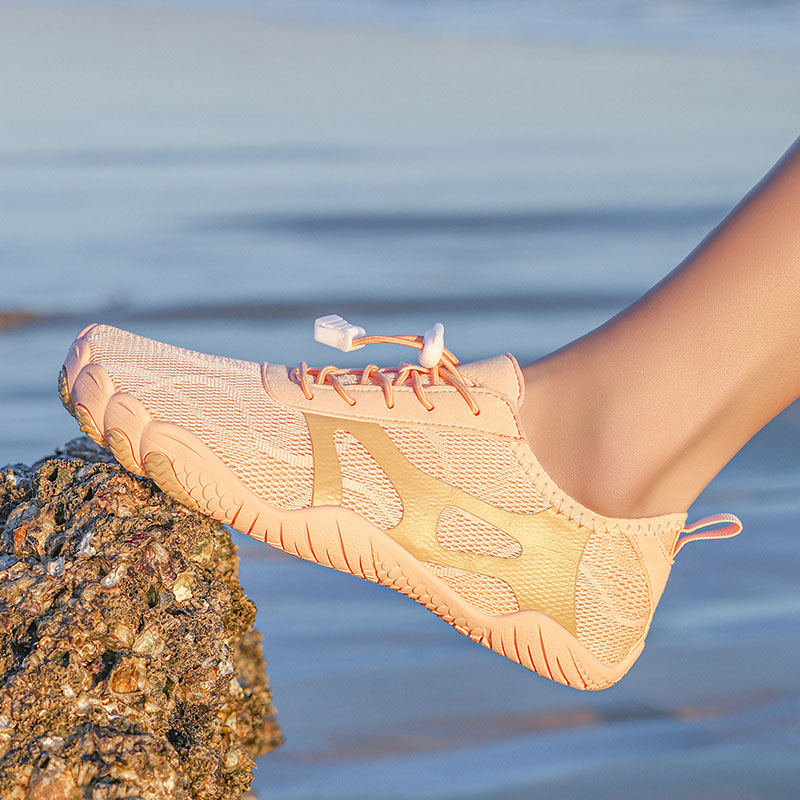
Trade-offs: They provide minimal underfoot protection against sharp rocks. They completely lack the arch support necessary for long hikes carrying heavy gear.
Design profile: These utilize an open architecture alongside adjustable strapping systems. They focus entirely on providing a locked-in heel fit.
Best for: Whitewater rafting, shallow wading, and hot-weather amphibious activities. They offer unmatched ventilation in tropical climates.
Trade-offs: You receive zero protection against silt, pebbles, or toe impacts. Debris easily enters and exits the footbed.
Design profile: Manufacturers build these using non-marking rubber. They feature razor-siped outsoles and slip-on designs. Lacing systems remain minimal to prevent snagging.
Best for: Sailing, deep-sea fishing, and navigating flat, wet synthetic surfaces.
Trade-offs: They deliver terrible performance on mud. They lack the traction required for natural uneven terrain.
Comparison Chart of Footwear Categories
Category | Primary Strength | Primary Weakness | Ideal Activity |
|---|---|---|---|
Amphibious Hikers | Maximum stability and protection | Slow drying time | Canyoneering |
Minimalist Shoes | Ground feel and flexibility | Poor arch support | SUP & Kayaking |
Performance Sandals | Unrestricted ventilation | Zero debris protection | Whitewater Rafting |
Deck Shoes | Grip on wet fiberglass | No traction in mud | Sailing |
Traction dictates your safety margin in aquatic environments. Manufacturers use two primary methods to generate grip.
Siping: Look closely at the rubber outsole. You will see microscopic slits cut into the material. As your foot flexes, these slits open up. They actively expel water out from under your foot. This mimics how a car tire avoids hydroplaning. Siping proves critical for smooth, wet surfaces like boats or paddleboards.
Lug depth and spacing: Natural terrain requires deep lugs. Lugs bite into mud and loose dirt. Wide lug spacing prevents mud buildup. If mud packs between the lugs, the shoe loses all traction immediately.
Rubber durometer: This measures rubber hardness. Softer, stickier rubber grips wet rocks beautifully. However, it degrades much faster on dry pavement. Harder rubber lasts longer but slips easily on wet river stones.
Rubber Durometer Suitability Chart
Rubber Type (Durometer) | Grip on Wet Rocks | Durability on Pavement | Best Application |
|---|---|---|---|
Soft / Sticky (Lower rating) | Excellent | Poor (wears out quickly) | River wading, slick boulder hopping |
Medium | Moderate | Moderate | Mixed trail and stream crossings |
Hard / Durable (Higher rating) | Poor (prone to slipping) | Excellent | Dry canyon hikes, concrete boat ramps |
Shoe designers constantly battle physics here. Allowing water to exit quickly usually allows sand to enter freely. You must decide which element frustrates you more.
Midsole drainage ports: Many shoes feature holes drilled directly through the bottom of the sole. These allow water to exit the bottom of the shoe rapidly. Unfortunately, they can let fine sand or silt push upward into the footbed.
Mesh gauge: The upper material dictates breathability. Wide mesh drains water instantly. Tightly woven engineered mesh drains slower. However, tight mesh prevents grit accumulation. Trapped grit causes severe blisters during long walks. When reviewing Multi-Sport Water Shoes, check the mesh density carefully to avoid unwanted sand intrusion.
Modern materials determine how heavy your shoes feel an hour after submersion.
Hydrophobic synthetics: Look for TPU (Thermoplastic Polyurethane) and treated EVA foams. These materials refuse water absorption completely. They shed moisture instantly. They keep the shoe incredibly light.
Neoprene: This material behaves differently. It deliberately retains a thin layer of water against your skin. Your body heat warms this trapped water. This creates a "wetsuit effect" to keep your feet warm in freezing rivers. The massive downside is drying time. Neoprene takes significantly longer to dry than hydrophobic mesh.
Buying the right shoe only solves half the problem. You must also understand how your feet behave in wet environments.
The friction multiplier: Wet skin softens dramatically. Soft skin is highly susceptible to blistering. A shoe feeling comfortable in a dry store might destroy your heel in a river. Quality shoes must feature seamless internal booties. Covered internal stitching mitigates severe friction risks.
The odor reality: Closed-toe shoes worn in natural bodies of water invite bacterial buildup. Algae, sweat, and stagnant water create terrible smells. Evaluate shoes featuring integrated anti-microbial footbeds. Alternatively, look for easily removable insoles. You can wash and dry removable insoles separately.
Break-in requirements: Never deploy brand-new water shoes on a multi-day trip. This invites disaster. You must test them in a controlled wet environment first. Wear them in a pool or a local stream. Identify pressure points immediately. Many stiff materials only reveal their friction zones once fully soaked.
Common Mistakes to Avoid:
Assuming regular running shoes can double as water gear. (They absorb pounds of water).
Ignoring toe protection in murky rivers.
Leaving wet shoes crumpled in a plastic bag overnight.
You now understand the mechanics of aquatic footwear. Follow this exact workflow to make your final purchase decision.
Audit your use cases: List the top three activities you will perform this season. Weight your decision heavily toward the most rigorous or dangerous activity. Do not buy shoes for the casual kayak paddle if you also plan to hike a slippery gorge. Buy the gorge-capable shoe.
Execute a smart sizing strategy: Water acts as a powerful lubricant. A shoe fitting perfectly dry will often feel loose when submerged. If you sit between two sizes, sizing down slightly often prevents heel slippage. Heel slippage causes immediate blisters.
Take your next actions: Narrow your choices down to two or three models across different categories. Pick one active amphibious hiker and one performance sandal. Review specific manufacturer sizing guides. Pay close attention to customer reviews regarding "wet-stretch" tendencies before purchasing.
Selecting aquatic footwear requires aligning outsole type, drainage mechanisms, and structural support with your specific environmental demands. There is no universal shoe for every body of water. A slick boat deck demands siped rubber. A muddy trail demands deep lugs. Neoprene warms you in cold currents, while open mesh cools you in tropical heat.
To ensure safety and comfort during amphibious activities, prioritize a secure, frictionless fit over aesthetic preferences. Your final action steps are simple:
Assess your primary environment using the 80/20 rule.
Determine whether you need rock protection or board flexibility.
Choose an outsole matching your terrain (siping for flat, lugs for mud).
Test the fit in a wet environment before undertaking any long expeditions.
A: No. Regular running shoes use open-cell foam and heavy cotton blends. They absorb massive amounts of water, doubling in weight. They also lack proper drainage ports. This traps moisture against your skin, accelerating blister formation and bacterial growth rapidly.
A: Generally, no. Most are designed with seamless interiors for barefoot wear. However, in cold environments, you can pair them with specialized neoprene booties or thin merino wool socks to retain heat. Never wear standard cotton socks.
A: Minimalist mesh models can dry in direct sunlight within two hours. Heavy amphibious hikers featuring thick toe caps and padded collars may require a full 24 hours in a well-ventilated space. Neoprene always extends the necessary drying time.
A: They should feel comfortably snug, not painfully tight. Water acts as a lubricant and stretches certain materials. A slightly snug dry fit prevents your foot from sliding around once the shoe becomes submerged, which prevents dangerous heel blisters.


