 English

Views: 0 Author: Site Editor Publish Time: 2026-08-11 Origin: Site


Navigating wet, algae-covered river rocks is one of the most hazardous environments for outdoor footwear, where a single slip can result in severe injury. Consumers frequently confuse "waterproof" or "water-resistant" shoes with footwear designed for actual aquatic traction, or mistakenly rely on bare feet and flip-flops which offer zero slip mitigation. Furthermore, traditional hiking treads inherently fail on wet rock because their geometry and rubber compounds are optimized for loose dirt, not smooth, lubricated surfaces. Selecting reliable footwear requires looking past marketing claims and evaluating the technical specifications of the outsole—specifically tread geometry, rubber durometer, water displacement mechanisms, and how the upper secures the foot to the sole.
Surface Area Over Deep Lugs: Effective wet rock traction relies on maximum rubber-to-rock contact rather than aggressive, deep lugs designed for mud.
Rubber Durometer is Critical: Softer rubber compounds deform around micro-textures in the rock, creating essential friction that hard rubber cannot achieve.
Siping Technology: Micro-cuts (siping) in the tread block channel water away from the contact patch, preventing hydroplaning on smooth surfaces.
The Durability Trade-Off: The stickiest rubber outsoles inherently wear down faster on dry, abrasive trails, requiring buyers to balance grip requirements with expected shoe lifespan.
Understanding what makes a water shoe effective requires defining the exact mechanics of a slip on wet rock. A slip occurs when the shear force applied by your foot exceeds the frictional resistance between the shoe's outsole and the rock's surface. The ultimate success criteria for high-performance wet rock traction footwear is the ability to step onto a smooth, angled river stone with your full body weight and remain completely static without sliding off.
Water fundamentally alters surface friction by acting as a hydrodynamic boundary layer. When you step on a wet rock, a thin film of water gets trapped between the rubber and the stone. If this water cannot escape, the shoe hydroplanes. The rubber glides over the surface with near-zero friction. Effective footwear must rapidly displace this water barrier before the rubber can physically engage with the rock's underlying texture. This requires mechanical intervention at the tread level to break the surface tension and channel the moisture away from the primary contact patch instantly upon impact.
The mechanics of a slip on wet rock generally follow a predictable sequence of failures:
Initial Contact: The heel or forefoot strikes the lubricated surface of the rock.
Water Trapping: The tread design fails to displace the hydrodynamic boundary layer.
Hydroplaning: The rubber loses physical contact with the stone, floating on the water film.
Shear Failure: The lateral force of your stride exceeds the zero-friction threshold, resulting in a rapid loss of balance.
Beyond simple water displacement, outdoor enthusiasts must contend with the biofilm factor. River slime, algae, and moss create a highly lubricated biological layer over the rock. No shoe can completely conquer thick, undisturbed algae on a steep incline. However, specific tread geometries and rubber formulations mitigate the risk significantly better than standard footwear. Defeating biofilm requires a combination of sharp tread edges that can cut through the organic layer and a soft enough rubber to find purchase on the microscopic irregularities of the rock beneath the slime.
The architectural elements of a high-performing water shoe outsole dictate its success in aquatic environments. Unlike traditional hiking boots that rely on deep, widely spaced lugs to dig into soft earth, aquatic footwear requires a completely different structural approach to maximize grip on hard, smooth surfaces.
Surface area maximization is the foundational principle of wet rock traction. Flat, wide tread blocks vastly outperform spiked or deep-lugged designs on smooth river stones. When you stand on a hard rock, deep lugs prevent the majority of the sole from touching the ground. Less rubber contacting the rock means less friction. High-quality non slip water shoes utilize broad, low-profile tread patterns that put as much rubber on the stone as possible. This distributes your weight evenly and maximizes the frictional coefficient.
To address the hydroplaning issue without sacrificing surface area, engineers utilize razor siping. Siping consists of ultra-thin slits cut directly into the flat rubber tread blocks. This technology was originally developed for winter car tires and sailing shoes. When the shoe is unweighted, these slits remain closed, maintaining a solid block of rubber. When you step down and the sole flexes, the sipes open up. This action creates hundreds of microscopic biting edges that cut through the water film. It simultaneously provides tiny channels for the water to escape from beneath the contact patch. The result is a dramatic increase in grip on slick, flat surfaces.
Lug spacing and debris shedding present a major design challenge. You want maximum flat surface area for rock grip, but water shoes are rarely used in pristine environments. Transitioning from a riverbed to a muddy bank introduces sand, gravel, and thick mud. If the tread channels are too narrow, the sole will pack with mud, completely neutralizing the rubber's grip. Manufacturers must strike a precise balance. They create channels wide enough to shed debris as the foot flexes, yet narrow enough to maintain a high percentage of rubber-to-rock contact.
Tread Geometry Comparison for Aquatic Environments
Tread Type | Water Displacement | Rock Contact Area | Mud Shedding Capability |
|---|---|---|---|
Deep Lugs (Hiking Boots) | Poor | Low | Excellent |
Flat Siped Soles (Sailing/Water Shoes) | Excellent | Maximum | Poor |
Hybrid Perimeter Lugs | Good | Moderate | Good |
The synergy of the tread and a secure fit cannot be overstated. Even the most advanced, siped tread geometry will fail if the shoe's upper lacks structural integrity. When you apply lateral pressure on an angled rock, the outsole might grip perfectly. If your foot slides off the footbed inside the shoe, you will lose balance and fall. A highly secure upper, featuring adjustable lacing, heel locks, and non-stretch materials, is mandatory. This ensures the traction generated by the outsole transfers directly to your foot and body.
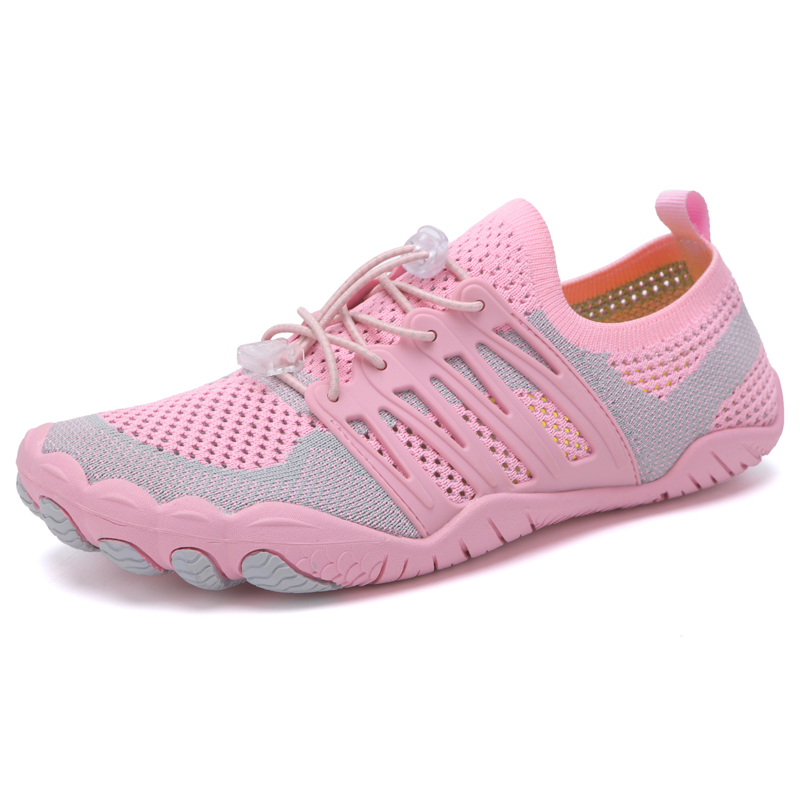
Tread geometry provides the mechanical structure for grip, but the chemical and physical properties of the rubber dictate the actual friction generated. Evaluating rubber outsole aqua shoes requires a close look at the durometer ratings of the materials used.
Durometer measures the hardness of a material, typically on the Shore A scale for footwear. Traditional hiking boots use harder rubber, often between 70A and 80A. This withstands miles of abrasion on granite and gravel without wearing down rapidly. Hard rubber acts like hard plastic on wet, smooth rocks. It slides. High-traction water shoes utilize a much lower durometer, meaning the rubber is significantly softer. Soft rubber has the unique ability to squish and deform under your body weight. This deformation allows the rubber to mold itself into the microscopic pores, pits, and crystals of the wet rock, drastically increasing the contact area and creating immense friction.
Shore A Durometer Ratings in Outdoor Footwear
Durometer Range | Rubber Hardness | Primary Application | Wet Rock Performance |
|---|---|---|---|
75A - 85A | Hard | Heavy backpacking boots, work boots | Poor (High slip risk) |
65A - 75A | Medium | Trail running shoes, light hikers | Moderate (Acceptable on dry rock) |
50A - 60A | Soft | Approach shoes, high-end water shoes | Excellent (Maximum friction) |
The outdoor industry relies on specialized, proprietary sticky rubber compounds to achieve this performance. Benchmarks in the industry include climbing-grade rubbers originally formulated for vertical rock climbing, where friction is a matter of life and death. By adapting these ultra-sticky chemical formulations for aquatic footwear, manufacturers provide users with unparalleled adhesion on slick riverbeds. When evaluating a shoe, identifying the specific proprietary rubber compound used is often the most reliable indicator of its wet-rock capabilities.
Temperature sensitivity is another factor often overlooked by consumers. Rubber compounds react to ambient temperatures. A shoe that feels soft and sticky in a warm summer river may harden significantly in near-freezing glacial meltwater. When rubber hardens, it loses its ability to deform around rock micro-textures. This results in a sudden and dangerous loss of grip. Specialized aquatic compounds are chemically engineered to maintain their flexibility and low durometer even in cold water environments, ensuring consistent traction regardless of the season.
Matching the tread geometry and rubber compound to your specific aquatic environment is necessary for safety and performance. No single shoe excels in every water-based scenario. Buyers must scale their footwear choice to their primary activity to get the best results out of their Non Slip Water Shoes.
Canyoneering and steep wet rock environments demand the absolute highest friction available. Navigating vertical drops, slick waterfalls, and polished slot canyons involves high-consequence movements where a slip can be catastrophic. Footwear for this use-case requires specific features:
The softest available climbing-adjacent rubber compounds.
Maximum surface contact with minimal to zero lug depth.
A highly rigid upper to support the ankle under heavy pack loads.
Reinforced toe caps to protect against rock strikes in fast-moving water.
Kayaking, Stand-Up Paddleboarding (SUP), and navigating smooth river beds present a different set of requirements. In these scenarios, users prioritize extreme flexibility, razor siping, and non-marking soles. Minimalist designs excel here. A highly flexible sole allows the foot to bend and wrap naturally around uneven rocks, increasing the contact patch through proprioception. These shoes often feature:
Extensive drainage ports to dump water quickly upon re-entering a boat.
Low-profile uppers that fit easily into the confined spaces of a kayak cockpit.
Heavily siped, flat outsoles that grip wet fiberglass and smooth river stones equally well.
Lightweight materials that dry rapidly to prevent rot and odor.
Amphibious hiking and steep mountain trails that cross multiple streams require a hybrid approach. A purely flat, sticky sole will fail on steep, muddy trail descents. A traditional hiking boot will fail on the wet river crossings. Hybrid water shoes feature moderate lugs around the perimeter of the sole for biting into dirt and mud, combined with a flat, siped, sticky rubber zone in the center of the foot for rock traction. Trying on these hybrid models in-store is highly recommended. The precise fit required for steep downhill hiking must be balanced with the drainage and grip required for aquatic use.
Purchasing high-performance aquatic footwear involves accepting realistic compromises. Engineering a shoe to excel on wet rock inherently limits its performance in other areas. Buyers must understand these trade-offs to make an informed decision.
The most prominent compromise is the battle between grip and durability. Soft, high-friction rubber degrades rapidly when subjected to high-abrasion environments. If you wear sticky rubber water shoes for extensive miles on dry pavement, concrete, or sharp gravel trails, the tread will wear flat in a fraction of the time a standard hiking boot would survive. Buyers must accept shorter lifespans for their aquatic shoes if they demand maximum wet rock performance.
Sole flexibility versus foot protection presents another challenge. Minimalist shoes offer superior proprioception, allowing your foot to contour to the rock for better grip and balance. This extreme flexibility means the shoe lacks a rigid underfoot rock plate. Walking across miles of sharp, jagged river stones in minimalist shoes can lead to severe foot fatigue and stone bruising. Conversely, a stiff shoe protects the bottom of the foot perfectly but bridges across uneven rocks, reducing the rubber contact area and increasing the likelihood of a slip.
The conflict between drainage and debris ingress must be managed. Shoes designed with extensive mesh panels and large drainage ports shed water instantly, keeping the shoe lightweight. These same ports are highly susceptible to letting in fine sand, silt, and small pebbles. Once debris enters the shoe, it causes severe blistering and compromises internal foot stability, negating the traction of the outsole. Tightly woven uppers keep sand out but take significantly longer to drain and dry.
Performance Trade-Offs in Aquatic Footwear Design
Design Feature | Primary Benefit | Inherent Trade-Off | Ideal Environment |
|---|---|---|---|
Ultra-Soft Rubber (Low Durometer) | Maximum friction and deformation on micro-textures. | Rapid tread degradation on dry, abrasive surfaces. | Canyoneering, polished river rocks, wet slabs. |
Minimalist Flexible Sole | High proprioception; foot wraps around uneven terrain. | High risk of stone bruising; poor support for heavy loads. | Kayaking, SUP, short portages, smooth riverbeds. |
Extensive Drainage Ports | Instant water shedding; rapid drying times. | Allows sand, silt, and small pebbles to enter the shoe. | Clear streams, boat decks, rocky shores without fine sand. |
Hybrid Perimeter Lugs | Provides bite in mud and loose dirt on trail approaches. | Reduces total flat surface area available for wet rock grip. | Amphibious hiking, backcountry fishing, varied terrain. |
Test the sole flexibility by bending the shoe in half to ensure it will contour to uneven river rocks and maximize surface contact.
Verify the rubber compound durometer with the manufacturer to confirm it falls in the soft, high-friction category designed specifically for wet environments.
Inspect the tread blocks for razor siping that opens up when you apply pressure with your thumb, ensuring adequate water displacement capabilities.
Lock your foot into the shoe and apply lateral pressure to ensure the upper prevents internal sliding and maintains your center of gravity.
A: Regular hiking boots use hard rubber compounds designed for durability and deep lugs designed to dig into loose dirt. On smooth, wet rocks, hard rubber fails to grip. Deep lugs reduce the surface area contacting the stone, leading to dangerous slips.
A: Siping refers to ultra-thin, razor-cut slits in the rubber tread blocks. When you step down and the sole flexes, these slits open up. This action channels water away from the contact patch and creates hundreds of microscopic biting edges to grip smooth, wet surfaces.
A: Soft rubber, indicated by a low durometer rating, compresses and deforms under your body weight. This allows the material to mold into the microscopic pores and crystalline structures of the rock. This deformation maximizes surface contact and generates significantly more friction than hard rubber.
A: The lifespan depends entirely on usage. Soft, high-friction rubber degrades quickly on abrasive surfaces. If used exclusively in water and on smooth rock, they can last multiple seasons. If you walk frequently on dry pavement or rough gravel trails, the tread may wear flat in a single season.
A: Minimalist shoes excel in aquatic environments because their extreme flexibility allows the foot to wrap around uneven rocks, maximizing rubber contact and proprioception. However, they lack underfoot protection. This makes them painful to use on sharp, jagged rocks for extended periods.
A: If the upper does not lock your foot securely to the footbed, your foot will slide internally when you step on an angled rock. Even if the rubber outsole maintains perfect grip on the stone, internal sliding shifts your center of gravity, causing you to lose balance and fall.
A: Rinse water shoes thoroughly with fresh, clean water after every use, especially after exposure to saltwater, mud, or algae. Use a stiff brush to clear debris from the siping channels. Air dry them away from direct, intense sunlight, which can prematurely harden and degrade the soft rubber compound.


